AI UGC or real creators: how to decide for your ads
By the Floow editorial team

AI UGC is advertising that imitates the style of a creator (close camera, direct tone, everyday situations), but with a character, voice or scenes generated by artificial intelligence. It works when you need to test many messages fast, your product is easy to explain and you don't need a complex physical demonstration.
A real creator is better when the proof is a lived experience or a precise demonstration. What you should never do is present an avatar as a real customer who has used the product. Once a message is validated, the usual answer is to combine both.
What AI UGC is and how it compares to the real thing
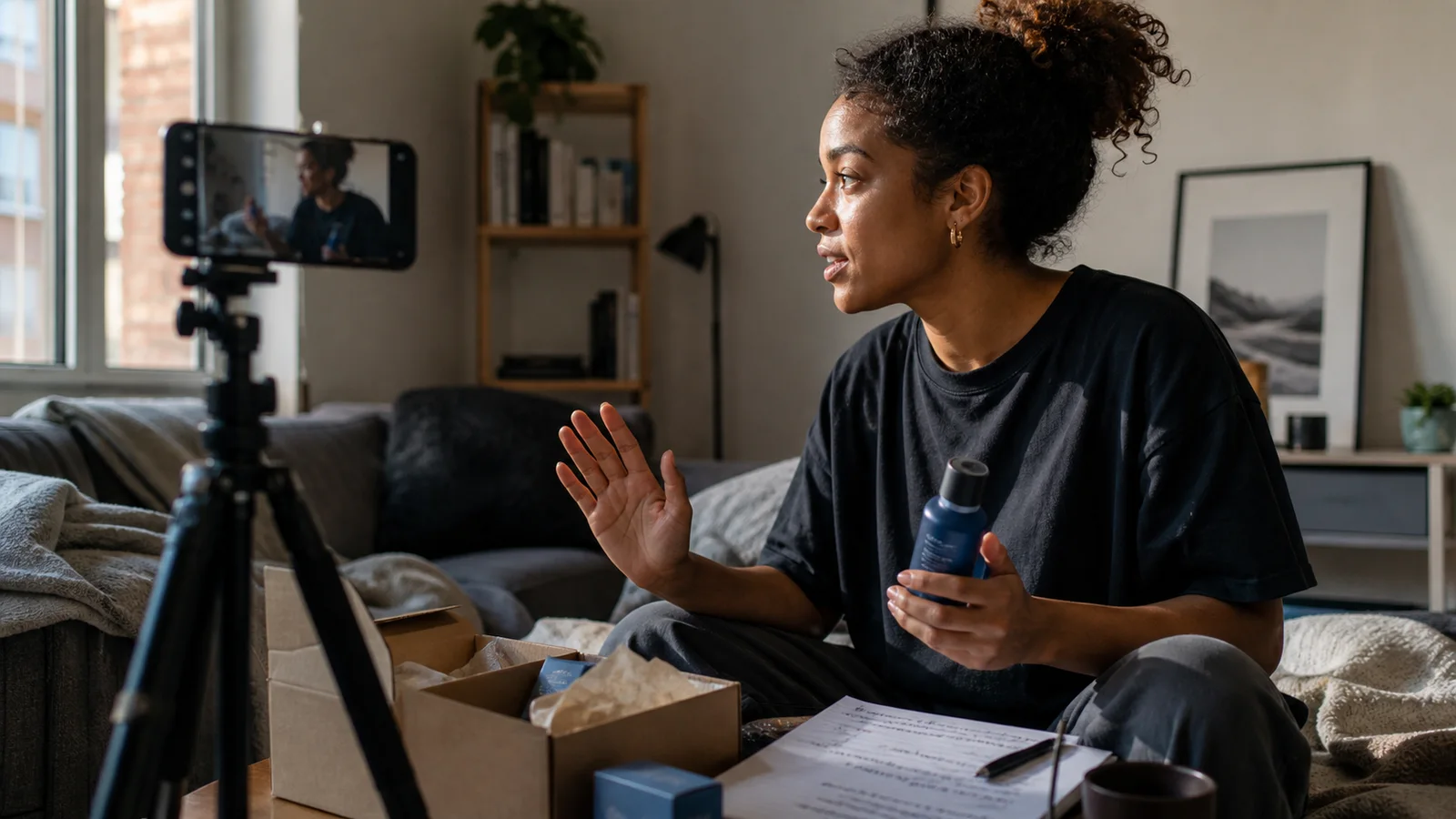
UGC stands for user-generated content. In its classic form, it's the video a customer or a hired creator shoots: phone in hand, no studio, in their own voice. AI UGC keeps that visual language, but part of the video wasn't filmed by a person: the avatar, the voice, the scene or the product inside the scene is generated with AI.
There are degrees. You can use AI only for the script and captions, and film yourself. You can use an avatar that talks to camera. Or you can start from a photo of your product and generate a video in which it appears in a scene. The more generated the video is, the more control you have, and the more careful you need to be about what it claims.
Why it's growing: cost, speed and variations
The reason is practical. A real creator means a brief, shipping the product, filming, review and sometimes a reshoot. With AI you turn a hypothesis into a reviewable piece in much less time, and you can make ten variants of one message without coordinating ten productions.
That fits how ad performance works: you almost never know in advance which angle will take off. If that's your starting point, look at how to get 12 genuinely different ads from one product page or which hooks work for a product nobody knows yet.
What AI does well today and where it shows
Today AI does well with scripts and hooks, avatars talking to camera, product-to-video, captions and variants of the same message. For exploring, that's more than enough.
If your ad loses the viewer after the first few seconds, the problem is usually not the tool but the script. We explain it in why your UGC ad feels like an ad. The limits are clear too:
- Odd hands and physics when the avatar handles the product.
- Uncanny valley: an almost-human face that creates distrust.
- Generic avatars that audiences already recognize.
- A lack of genuine emotion, especially in moments of surprise or relief.
When to choose AI, a real creator or a mix
The useful question is not which one wins in general, but what proof the buyer needs in order to trust you: a demonstration, a lived experience, or simply seeing different messages. Crossed with the stage of the campaign, it gives you a practical guide:
- Exploring the message with a product that's easy to explain: AI.
- Precise physical demonstration (textures, fit, assembly): real creator.
- Extended experience or personal result as proof: real creator.
- Health, money or other sensitive sectors: real creator, with legal review.
- Validated message and a need to scale: a mix, with AI for variants and a creator for the winning concept.
An example: ten AI hooks and a single creator
Imagine, as a hypothetical case, an online cosmetics store that wants to launch a hand cream. It doesn't know whether it will sell better with the angle of working with dry hands, gifting, or texture. It generates ten hooks with AI, each with the same ad body, and launches them with a small budget.
Two hooks stand out in retention and clicks. One talks about cracked hands after washing them many times a day, and the other about texture. Of the two, it picks the cracked-hands one and shoots it with a real creator, who uses the cream for two weeks and describes what she noticed. The other eight are dropped without having paid for eight productions.
The learning goes both ways: the real shoot also reveals details (how it's applied, what people say when they try it) that improve the next scripts. To validate with good judgment, review what to change when a winning ad stops working.
What to say and what to check before publishing
An avatar can't say "I used it for 30 days" or invent a review or a result. That deceives the buyer, and it can also clash with platform policies and advertising regulations.
On legality and disclosing that it's AI: platforms require, or may require, labeling realistic synthetic content, and you should check their current policy before launching. The rules depend on the country and change quickly, so consult the TikTok and Meta policies and, if you sell in sensitive sectors, a legal professional.
At Floow we create AI product videos for ads. And when a concept already works, the next step is usually to film it with a real person.
Before publishing, check that:
- Every claim in the script can be verified.
- No testimonial is made up.
- If the realism could confuse people, the video is labeled as AI-generated content.
- The hands and the product are consistent from start to finish.
- The product you see is the one you'll ship.